


Neck Muscles
The neck acts as a bridge between the head and the rest of the body. Its function goes beyond simply connecting these regions, as it also helps maintain the stability of the head and cervical spine while allowing a wide range of head movements. The musculature of the neck plays a key role in these functions. There are over 30 paired and unpaired muscles in the neck that work in coordination to facilitate movement, stabilize the cervical spine, and assist in actions such as head extension and rotation, as well as swallowing and breathing.
List of Muscles in the Neck
The muscles of the neck can be divided into three main groups based on their location at the front, sides, or back of the neck. Muscles that act on the larynx and pharynx are also included among the neck muscles because of their anatomical position.
Anterior Neck Muscles
The muscles in this group are primarily involved in elevating and depressing the hyoid bone, along with the larynx, to help protect the airways during swallowing and resuming normal breathing afterward. Exceptions include the platysma, sternocleidomastoid, and the scalene muscles, which have different functions.
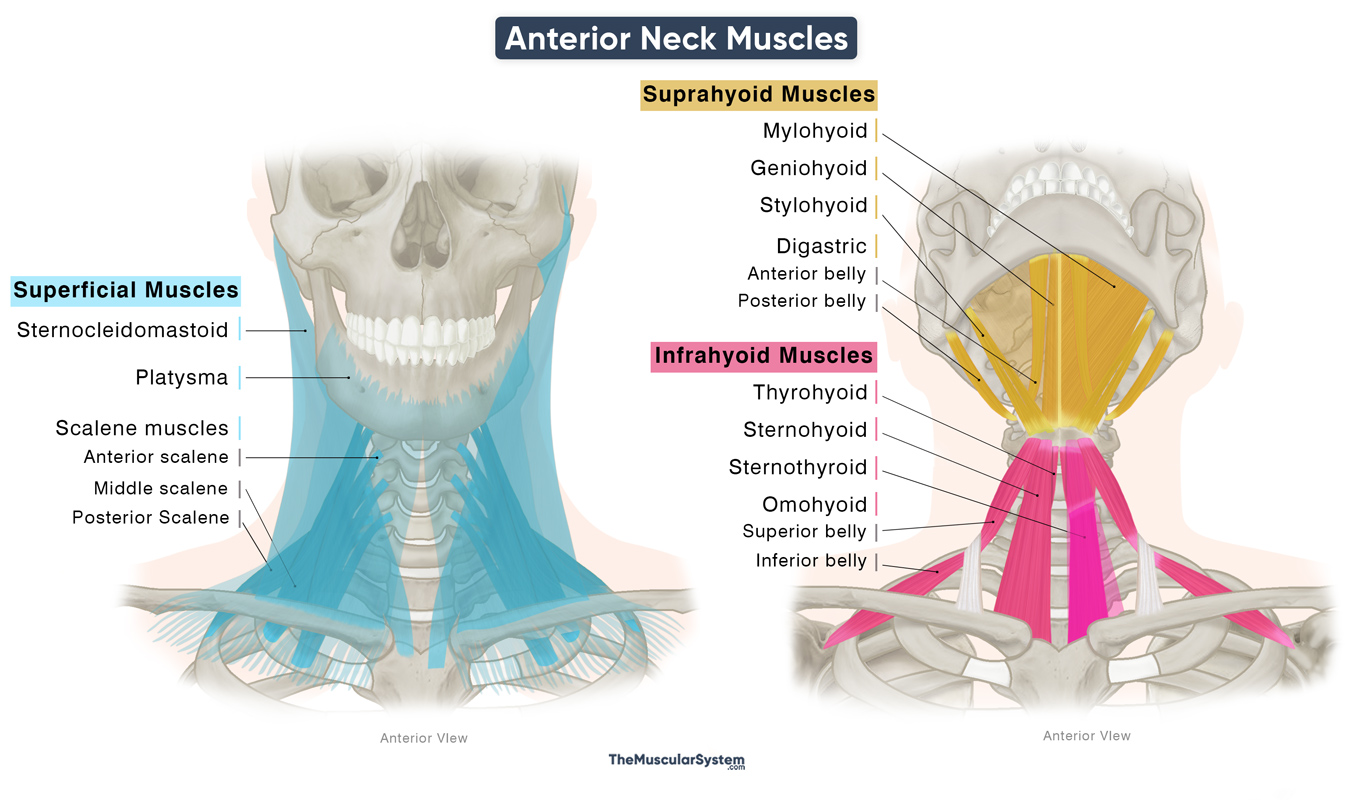
Anterior Neck Muscles
| Name | Action |
|---|---|
Superficial Muscles |
|
| Platysma | Helps with facial expression and neck movement |
| Sternocleidomastoid | Flexing and rotating the head |
| Scalene muscles | |
| — Anterior scalene | Lifting the first rib, flexing and rotating the neck |
| — Middle scalene | Lifting the first rib and flexing the neck sideways |
| — Posterior scalene | Lifting the second rib and flexing the neck sideways |
Suprahyoid Muscles |
|
| Digastric | Lowering the jaw and elevating the hyoid |
| Geniohyoid | Elevating the hyoid and flexing the neck |
| Mylohyoid | Elevating the hyoid and floor of the mouth |
| Stylohyoid | Elevating and retracting the hyoid |
Infrahyoid Muscles |
|
| Omohyoid | Depressing and stabilizing the hyoid and larynx after swallowing to resume breathing |
| Sternohyoid | Depressing the hyoid and larynx after swallowing |
| Sternothyroid | Depressing the hyoid and larynx after swallowing |
| Thyrohyoid | Stabilizing the hyoid and elevating the larynx to help with swallowing |
The sternocleidomastoid is a primary rotator of the neck and one of the largest muscles of the neck.
Lateral Neck Muscles
These are paired muscles located deep in the neck, stabilizing the cervical spinal column and forming the sides of the neck. They are the primary deep neck flexors, working alongside the superficial flexors, the sternocleidomastoid, and the scalene.
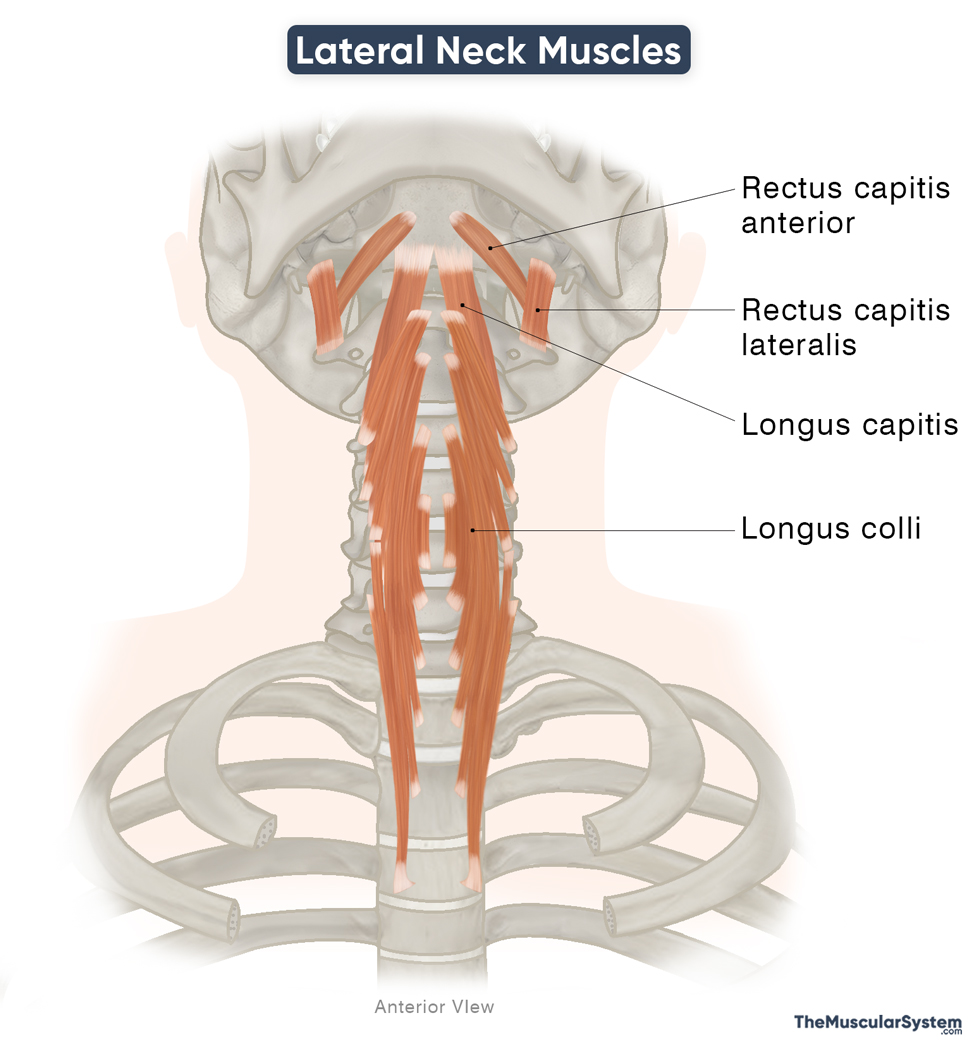
Lateral Neck Muscles
Here’s a list of the muscles located on the sides of the neck:
| Name | Action |
|---|---|
| Longus capitis | Flexing the neck and stabilizing the cervical spine |
| Longus colli | Flexing and slightly rotating the neck, and stabilizing the cervical spine |
| Rectus capitis anterior | Flexing the head at the neck and stabilizing the atlanto-occipital joint |
| Rectus capitis lateralis | Stabilizing the atlanto-occipital joint and (weakly) flexing the neck sideways |
Posterior Neck Muscles
More than half of the muscles forming the posterior neck actually belong to the back muscle group. This is because most of the intrinsic muscles of the back run along the vertebral column. Their cervical portions constitute a major part of the posterior neck’s deep muscular structure. These are also the major extensors of the neck, helping with straightening and stabilizing the head on the neck.
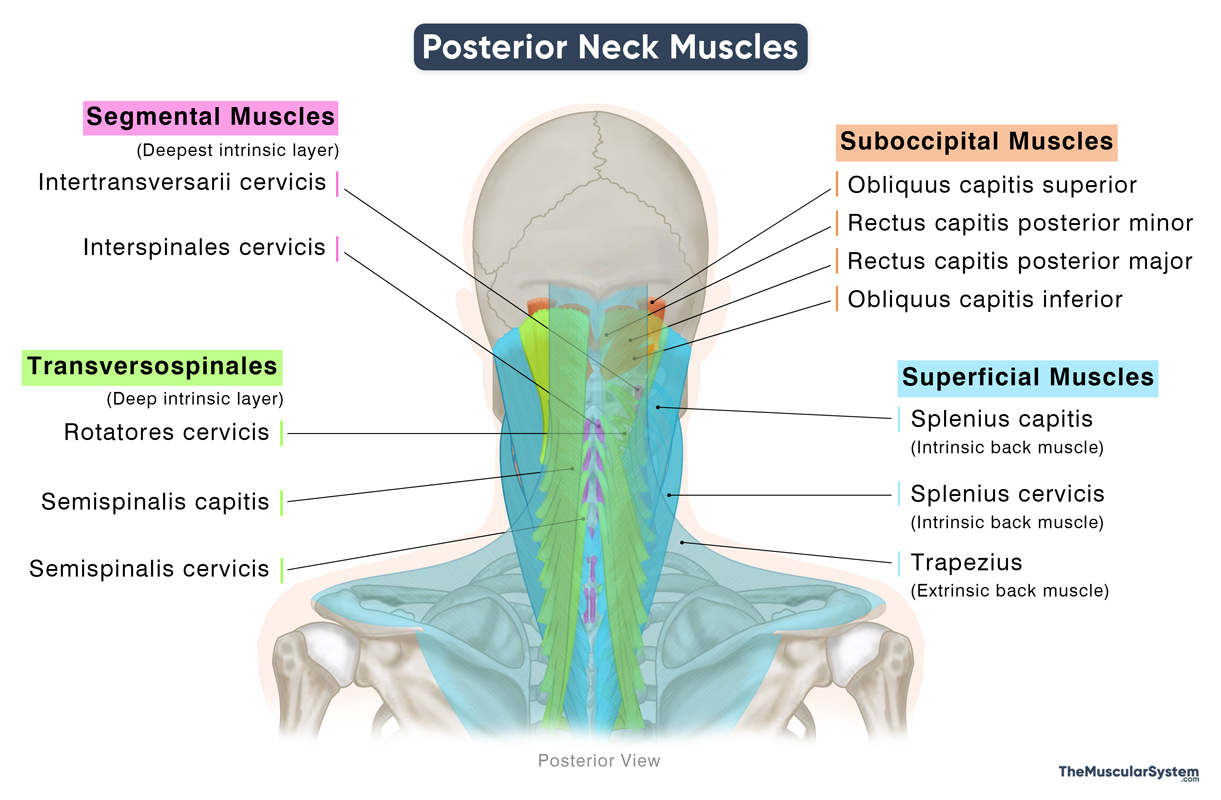
Posterior Neck Muscles
| Name | Action |
|---|---|
Suboccipital Muscles |
|
| Obliquus capitis inferior | Extending the neck and rotating the head to the same side, and stabilizing the atlanto-axial joint |
| Obliquus capitis superior | Extending and slightly bending the head sideways, and stabilizing the atlanto-occipital joint |
| Rectus capitis posterior major | Extending and rotating the head to the same side |
| Rectus capitis posterior minor | Extending the neck (weakly) |
Superficial MusclesDespite being classified as back muscles, these form the superficial musculature of the back of the neck. |
|
| Trapezius
(Extrinsic back muscle) |
Extending and rotating the neck |
| Splenius capitis
(Superficial intrinsic back muscle) |
Extending and rotating the neck |
| Splenius cervicis
(Superficial intrinsic back muscle) |
Extending and rotating the neck |
Transversospinales |
|
| Rotatores cervicis
(Deep intrinsic back muscle) |
Rotating the neck |
| Semispinalis capitis
(Deep intrinsic back muscle) |
Stabilizing the cervical spine |
| Semispinalis cervicis
(Deep intrinsic back muscle) |
Extending and slightly rotating the neck |
Segmental Muscles |
|
| Interspinales cervicis
(Deepest intrinsic back muscle) |
Stabilizing the cervical spine and extending the neck |
| Intertransversarii cervicis
(Deepest intrinsic back muscle) |
Stabilizing the cervical spine |
Pharyngeal Muscles
These muscles play an important role in swallowing by coordinating the opening and closing of the pharynx, guiding food into the esophagus while preventing it from entering the nasal cavity.
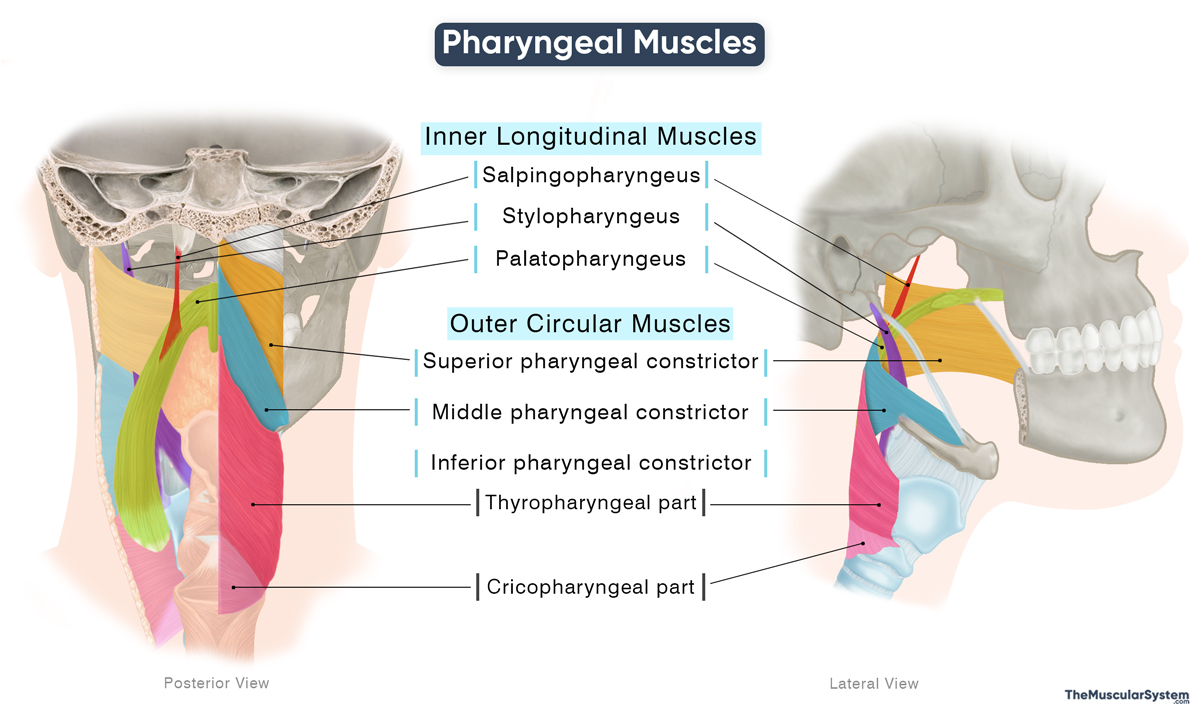
Pharyngeal Muscles
| Name | Action |
|---|---|
| Superior pharyngeal constrictor | Constricting the upper pharynx during swallowing |
| Middle pharyngeal constrictor | Constricting the middle pharynx during swallowing |
| Inferior pharyngeal constrictor | Constricting the lower pharynx during swallowing |
| Stylopharyngeus | Elevating and widening the pharynx during swallowing |
| Salpingopharyngeus | Elevating the pharynx during swallowing |
| Palatopharyngeus
(Muscle of the soft palate) |
Elevating the pharynx and closing the nasopharynx |
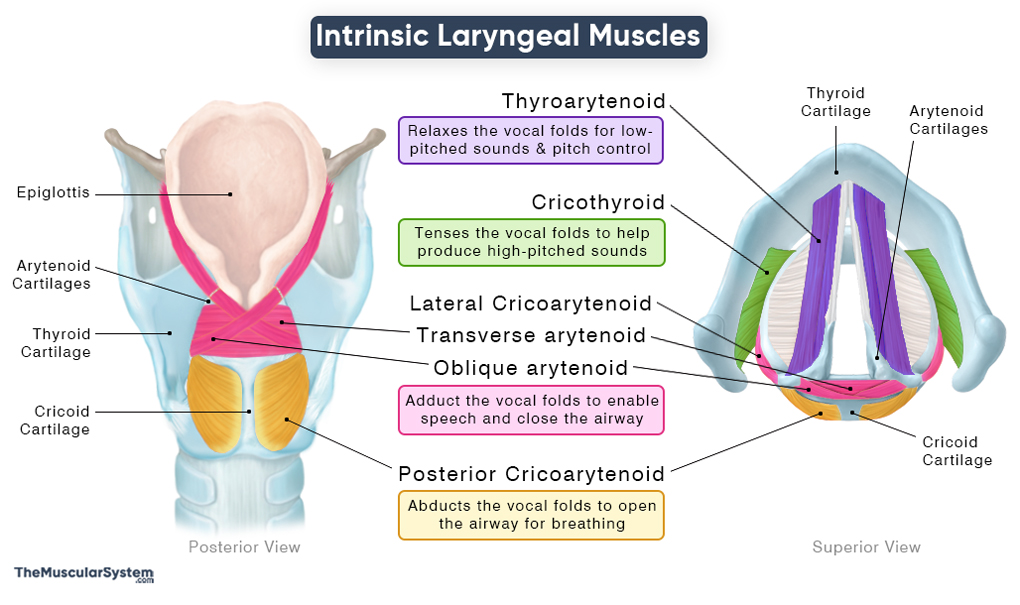
Laryngeal Muscles (Intrinsic)
These muscles are involved in controlling the position and movement of the larynx, supporting voice production, breathing, and airway protection during swallowing.
Intrinsic Muscles of the Larynx
| Name | Action |
|---|---|
| Cricothyroid | Tensing and lengthening the vocal folds, raising pitch |
| Posterior cricoarytenoid | Abducting (opening) the vocal folds, allowing breathing |
| Lateral cricoarytenoid | Adducting (closing) the vocal folds, helping with speech |
| Oblique arytenoid | Adducting the vocal folds and narrowing the rima glottidis, helping with speech |
| Transverse arytenoid | Adducting the vocal folds completely to protect the airways and help with speech |
| Thyroarytenoid | Relaxing and shortening the vocal folds, lowering the pitch |
In addition to the intrinsic muscles, the suprahyoid and infrahyoid muscles also act as extrinsic laryngeal muscles, by elevating or depressing the larynx during swallowing, speech, and breathing.
References
- Neck Muscles: ClevelandClinic.org
- Muscles of the Neck: Anatomy: Lecturio.com
- Muscles of the Neck: An Overview: Kenhub.com
- Muscles of the Neck: TeachMeAnatomy.info


