


Sternohyoid
By
Della Barnes, an MS Anatomy graduate, blends medical research with accessible writing, simplifying complex anatomy for a better understanding and appreciation of human anatomy.
 Della Barnes, MS Anatomy
Last updated:
09/12/2025 Della Barnes, MS Anatomy
UX/UI Designer at - AdobeDella Barnes, an MS Anatomy graduate, blends medical research with accessible writing, simplifying complex anatomy for a better understanding and appreciation of human anatomy.
What is the Sternohyoid
The sternohyoid is a long, paired, strap muscle running vertically down the front of the neck. It is one of the infrahyoid muscles, along with the thyrohyoid, sternothyroid, and omohyoid. Additionally, it is an extrinsic laryngeal muscle and plays an important role in lowering the hyoid bone and supporting movements such as swallowing and respiration.
Anatomy
Location and Attachments
| Origin | Posterior surface of the sternal end of the clavicle and the manubrium |
| Insertion | Inferior border of the body of the hyoid bone |
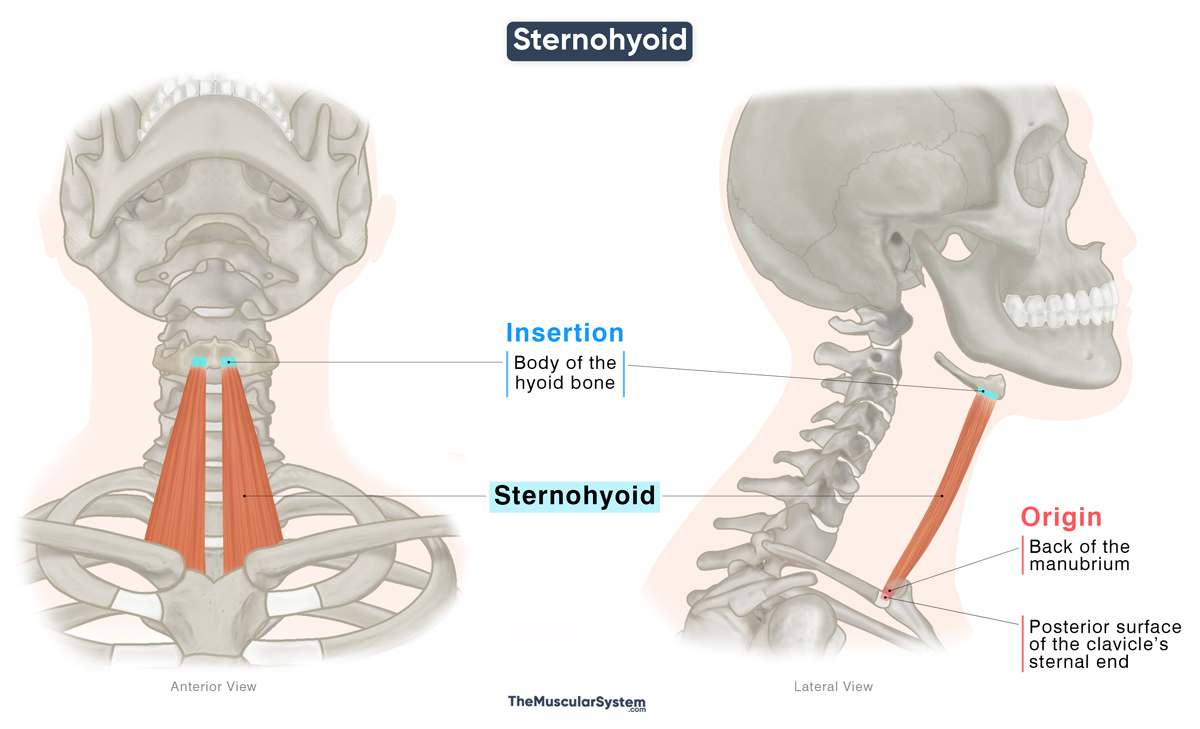
Origin
The muscle has a broad origin that involves three points:
- The back of the sternal end of the clavicle
- The upper posterior aspect of the manubrium of the sternum
- Along the back of the sternoclavicular ligament
Insertion
Though the muscle fibers of the left and right sternohyoid lie quite far apart as they course upward along the neck, they align obliquely to come closer together. They insert into the lower border of the body of the hyoid bone.
Relations With Surrounding Muscles and Structures
The sternohyoid lies within the inferior carotid triangle of the neck with the other infrahyoid muscles. In this region, it lies deep to the platysma and superficial to the larynx and thymus. The muscle laterally borders the trachea on both sides.
Among the infrahyoid group, the sternothyroid and thyrohyoid muscles lie deep to it. The superior belly of the omohyoid runs lateral to it. Together with the sternothyroid, the sternohyoid forms a plane that separates the superficial anterior jugular vein from the deeper common carotid artery.
Variations
It may vary in size and shape. In some individuals, the contralateral muscles may be fused or even absent on one or both sides. In rare cases, the muscle may originate from the intermediate tendon of the omohyoid rather than from the manubrium. An additional accessory slip, known as the cleidohyoid, may also be present. When present, it extends from the clavicle to the hyoid bone, and may help stabilize the area during swallowing and breathing.
Function
| Action | Depressing the hyoid bone and larynx to help with breathing |
As part of the infrahyoid muscle group, the sternohyoid depresses the hyoid bone, returning it to its anatomical position after it has been elevated during swallowing or speaking. Lowering the hyoid also helps pull the larynx downward, reopening the airway after swallowing so that breathing can resume.
In addition, the sternohyoid also contributes to minor head and neck movements.
Antagonists
Although it does not have a specific antagonist, its function as an infrahyoid muscle is opposed by the suprahyoid group, mylohyoid, stylohyoid, digastric, and geniohyoid These muscles elevate the hyoid bone, while the infrahyoid muscles depress it.
Innervation
| Nerve | Ansa cervicalis (C1-C3) |
Innervation to this muscle is provided by the ansa cervicalis, a nerve loop created by contributions from the anterior rami of the first three cervical spinal nerves (C1 through C3).
Blood Supply
| Artery | Infrahyoid branch of the superior thyroid artery |
It receives blood supply from the infrahyoid branch of the superior thyroid artery, which in turn branches off the external carotid artery.
References
- Anatomy, Head and Neck, Sternohyoid Muscle: NCBI.NLM.NIH.gov
- Sternohyoid Muscle: Kenhub.com
- Sternohyoid: TeachMeAnatomy.info
- Sternohyoid Muscle: Elsevier.com
- Sternohyoid Muscle: Radiopaedia.org
Della Barnes, an MS Anatomy graduate, blends medical research with accessible writing, simplifying complex anatomy for a better understanding and appreciation of human anatomy.
- Latest Posts by Della Barnes, MS Anatomy
-
Tensor Tympani
- -
Stapedius
- -
Auricularis Posterior
- All Posts


