


Posterior Cricoarytenoid
By
Della Barnes, an MS Anatomy graduate, blends medical research with accessible writing, simplifying complex anatomy for a better understanding and appreciation of human anatomy.
 Della Barnes, MS Anatomy
Last updated:
06/01/2026 Della Barnes, MS Anatomy
UX/UI Designer at - AdobeDella Barnes, an MS Anatomy graduate, blends medical research with accessible writing, simplifying complex anatomy for a better understanding and appreciation of human anatomy.
The posterior cricoarytenoid is a small paired muscle located deep in the larynx. It is one of the six intrinsic laryngeal muscles, with the others being the cricothyroid, lateral cricoarytenoid, oblique arytenoid, transverse arytenoid, and thyroarytenoid.
It is the only abductor of the vocal folds and plays a vital role in both breathing and vocalization.
Anatomy
Location and Attachments
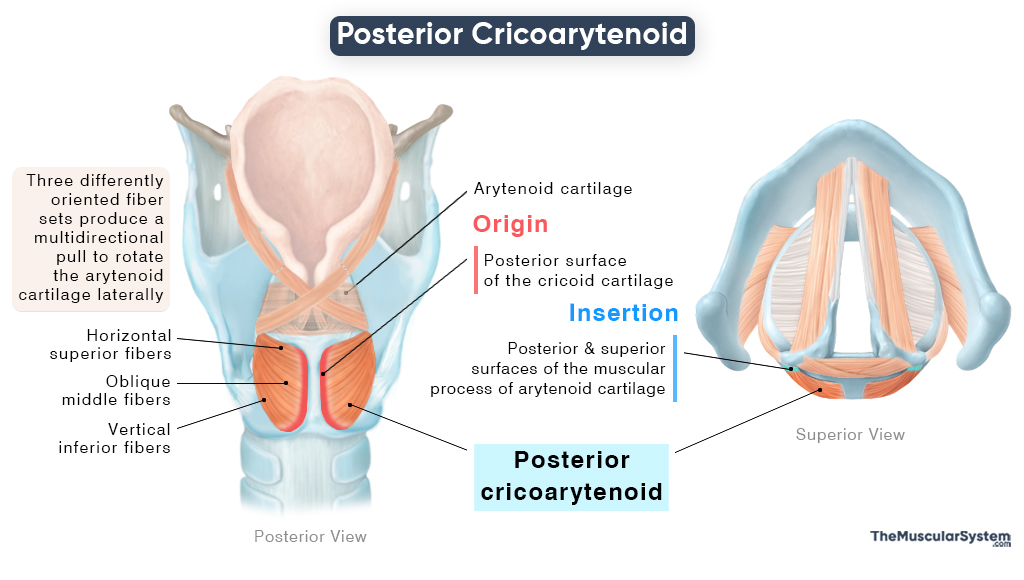
| Origin | Posterior surface of the cricoid cartilage |
| Insertion | Posterior and superior surfaces of the muscular process of arytenoid cartilage |
Origin
The muscle has a broad origin, with its fibers covering the entire length of the posterior surface of the cricoid cartilage’s lamina.
Insertion
From their origin, the muscle fibers form a broad belly and quickly converge into a single narrow tendon that inserts into the posterior and superior aspects of the muscular process of the arytenoid cartilage. As they converge toward this narrower point of insertion, the superior fibers course more horizontally, the middle fibers obliquely, and the inferior fibers more vertically.
Although some studies divide the muscle into vertical and horizontal bellies based on their orientation and differences in fiber type, the muscle is generally regarded as a single unit with differently oriented fibers. Like a rope tied to multiple points on an object, this arrangement allows the muscle to exert a coordinated pull in multiple directions when it contracts.
Relations With Surrounding Muscles and Structures
The broader part of the muscle belly covers the back of the cricoid cartilage, occupying the space below the transverse and oblique arytenoid muscles, which also originate from the cricoid cartilage. It shares its insertion with the lateral cricoarytenoid muscle, which lies superficially.
The recurrent laryngeal nerve branches course along the back of this muscle, as they innervate the different muscles of the larynx.
Function
| Action | Abducting the vocal folds to help with breathing and vocalization |
Role in respiration
As already mentioned, it is the only muscle that abducts the vocal folds to help open the rima glottidis. When it contracts, it pulls the muscular process of each arytenoid cartilage posteriorly and medially via their varied orientation. This rotates the arytenoids laterally on the cricoid lamina. This pulls on the vocal folds, separating them and opening the rima glottidis, thereby opening the glottis for airflow during respiration, particularly during deep inspiration.
As it is the sole abductor of the vocal folds, and therefore the only muscle working to open the rima glottidis, paralysis of this muscle can lead to life-threatening obstruction of the airways. This shows that the muscle is more vital for breathing than for voice.
Role in vocalization
It does not directly contribute to vocalization, as vocalization requires adduction rather than abduction of the vocal folds. Still, it assists the other muscles by abducting the vocal folds after phonation, to reopen the glottis to allow airflow for breathing between speech.
Antagonists
The lateral cricoarytenoid muscle, which rotates the arytenoid cartilage medially and helps close the rima glottidis, is antagonistic to the posterior cricoarytenoid.
Innervation
| Nerve | Inferior laryngeal branch of the recurrent laryngeal nerve |
The muscle is innervated by the inferior laryngeal nerve, the terminal branch of the recurrent laryngeal nerve, which provides motor innervation to most intrinsic laryngeal muscles. The recurrent laryngeal nerve is a branch of the vagus nerve (CN X).
Blood Supply
| Artery | Superior and inferior thyroid arteries |
Its blood supply comes from the laryngeal branches of the superior thyroid artery, which arises from the external carotid artery, as well as from the inferior thyroid artery, a branch of the thyrocervical trunk.
References
- Posterior Cricoarytenoid Muscle: Kenhub.com
- Posterior Cricoarytenoid Muscle: IMAIOS.com
- Posterior Cricoarytenoid: TeachMeAnatomy.info
- Posterior Cricoarytenoid Muscle: Elsevier.com
- Intrinsic Muscles of the Larynx:Radiopaedia.org
Della Barnes, an MS Anatomy graduate, blends medical research with accessible writing, simplifying complex anatomy for a better understanding and appreciation of human anatomy.
- Latest Posts by Della Barnes, MS Anatomy
-
Tensor Tympani
- -
Stapedius
- -
Auricularis Posterior
- All Posts


