


Oblique Arytenoid
By
Della Barnes, an MS Anatomy graduate, blends medical research with accessible writing, simplifying complex anatomy for a better understanding and appreciation of human anatomy.
 Della Barnes, MS Anatomy
Last updated:
31/12/2025 Della Barnes, MS Anatomy
UX/UI Designer at - AdobeDella Barnes, an MS Anatomy graduate, blends medical research with accessible writing, simplifying complex anatomy for a better understanding and appreciation of human anatomy.
The oblique arytenoid is a small, paired, intrinsic muscle belonging to the group of laryngeal muscles. It forms the arytenoid muscle together with the transverse arytenoid; the two muscles are often considered two parts of the arytenoid rather than two separate muscles. However, they have separate attachments and orientations.
It is one of the adductors of the laryngeal muscles, helping protect the airways during swallowing and with vocalization.
Anatomy
Location and Attachments
| Origin | The muscular process of the arytenoid cartilage on one side |
| Insertion | The apex and back of the arytenoid cartilage on the contralateral side |

Origin
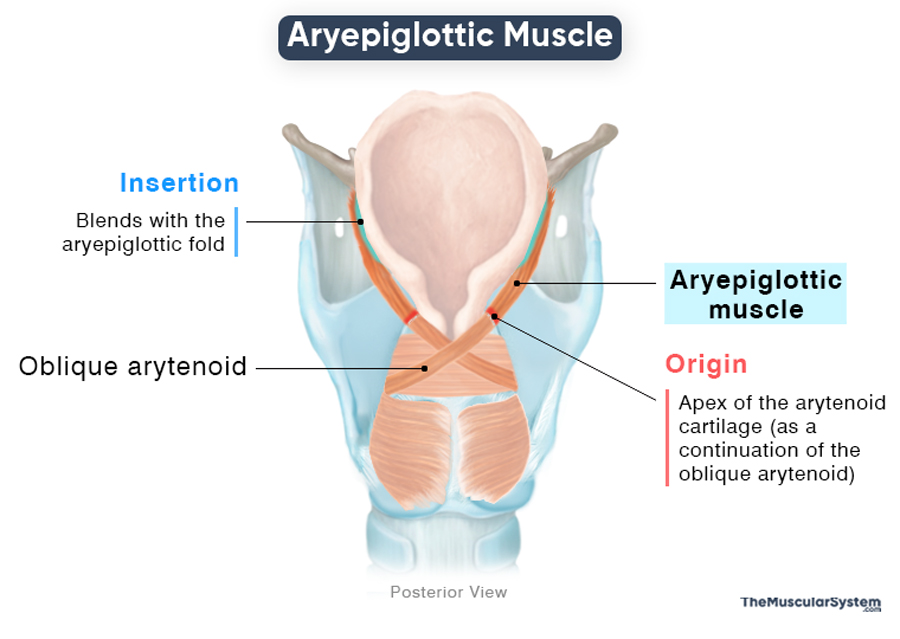
The fibers of the contralateral muscles originate from the back of the muscular process of the arytenoid cartilage on each side. From there, the fibers ascend medially and slightly posteriorly as they run toward the midline.
Insertion
The contralateral fibers cross each other as they cross the midline to reach the arytenoid cartilage of the opposite side, where they insert into its apex and posterior surface. This oblique orientation of the contralateral fibers gives the muscle its name and its “X” shape.
Relations With Surrounding Muscles and Structures
The transverse arytenoid muscle lies deep to the oblique arytenoid. One portion of the muscle’s fibers ascends laterally past the apex of the arytenoid cartilage to blend with the aryepiglottic fold, forming the aryepiglottic part of the oblique arytenoid, also referred to as the aryepiglottic muscle. Though small, it is also usually considered a separate muscular structure.
Function
| Action | — Working as a sphincter to close the laryngeal opening during swallowing and coughing — Helping with vocalization |
Sphincter action on the laryngeal inlet
When the muscle contracts, its unique X-shaped fibers pull the arytenoid cartilages together like a drawstring bag. This action indirectly pulls the aryepiglottic folds inward via this muscle’s connection to the aryepiglottic muscle. Finally, it results in narrowing of the back of the rima glottidis, the opening between the vocal folds.
This is how the oblique arytenoid contributes to the sphincter action of the laryngeal inlet, which protects the airways during swallowing and coughing, preventing food particles, mucus, and dust from entering.
Role in vocalization
When the oblique arytenoid works with other laryngeal muscles, adductors like the lateral cricoarytenoid, transverse arytenoid, and thyroarytenoid, and tensors like the cricothyroid, the posterior rima glottidis closes and the vocal cords (or folds) tense. Expelled air passing through this narrow opening causes the vocal folds to vibrate, producing voice.
If the oblique arytenoid is relaxed while the other adductors remain contracted, the posterior rima glottidis stays slightly open. Air can still pass through without significant vibration of the vocal cords, resulting in whispering, where speech occurs without true vocal pitch or tone.
Antagonists
The muscle has no direct antagonist; however, its role in adducting the vocal folds is functionally opposed by the posterior cricoarytenoid, the sole abductor of the vocal folds.
Innervation
| Nerve | Recurrent laryngeal nerve |
Like most muscles of the pharynx, both the oblique arytenoid and its aryepiglottic part are innervated by the recurrent laryngeal nerve, which rises from the vagus nerve (CN X).
Blood Supply
| Artery | Superior and inferior thyroid arteries |
Blood supply to the main muscle and the aryepiglottic part comes from the laryngeal branches of the superior thyroid artery, a branch of the external carotid artery, and the inferior thyroid artery, a branch of the thyrocervical trunk.
References
- Oblique Arytenoid: Meddean.LUC.edu
- Oblique Arytenoid Muscle: Kenhub.com
- Oblique Arytenoid Muscles (Anatomy): PrimaryCareNotebook.com
- Oblique Arytenoid Muscle: Elsevier.com
- Anatomy, Head and Neck: Larynx Arytenoid Cartilage: NCBI.NLM.NIH.gov
- Aryepiglottic Part of Oblique Arytenoid Muscle: Elsevier.com
Della Barnes, an MS Anatomy graduate, blends medical research with accessible writing, simplifying complex anatomy for a better understanding and appreciation of human anatomy.
- Latest Posts by Della Barnes, MS Anatomy
-
Tensor Tympani
- -
Stapedius
- -
Auricularis Posterior
- All Posts


