


Corrugator Supercilii
By
Della Barnes, an MS Anatomy graduate, blends medical research with accessible writing, simplifying complex anatomy for a better understanding and appreciation of human anatomy.
 Della Barnes, MS Anatomy
Last updated:
03/02/2026 Della Barnes, MS Anatomy
UX/UI Designer at - AdobeDella Barnes, an MS Anatomy graduate, blends medical research with accessible writing, simplifying complex anatomy for a better understanding and appreciation of human anatomy.
The corrugator supercilii (pronounced as kor-uh-GAY-ter soo-per-SIL-ee-eye) is a small, narrow, paired muscle with a pyramidal shape, located along the medial side of the eyebrows. It is one of the primary glabellar, or “frowning” muscles, along with the procerus, orbicularis oculi, and depressor supercilii. These muscles work together to depress the brows, creating the vertical lines between the eyebrows, often referred to as the frown lines or worry lines.
Anatomy
Location and Attachments
| Origin | Medial side of the superciliary arch (frontal bone) |
| Insertion | The skin above the middle one-third of the supraorbital margin (frontal bone) |
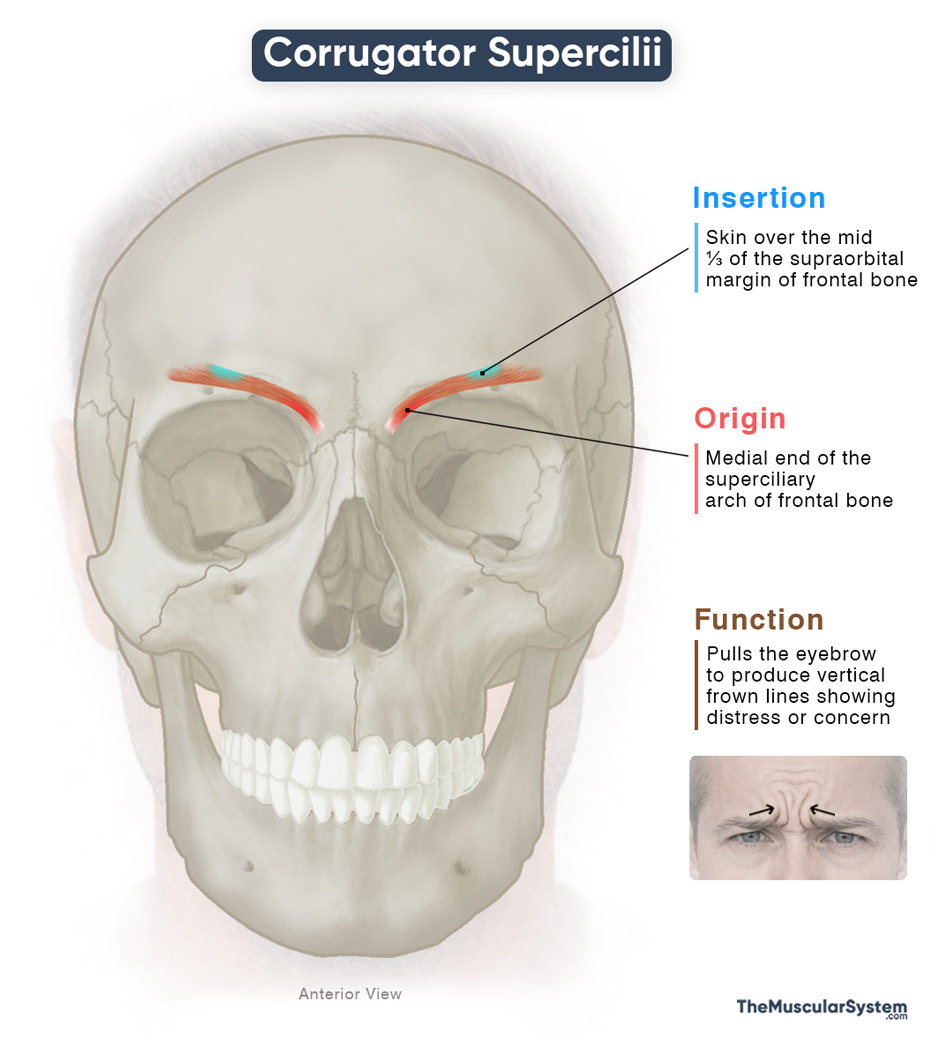
Origin
The muscle originates from the medial side of the superciliary arch, or the brow ridge, on the frontal bone.
Insertion
From its origin, the fibers run diagonally and slightly upward toward the lateral side to attach to the deep layer of skin above the middle of the eyebrow, over the supraorbital margin of the frontal bone.
Relations With Surrounding Muscles and Structures
It lies deep to the frontalis, which covers most of the forehead, and to the orbicularis oculi, the muscle that encircles the eyelids. Around the eyebrow region, some of its fibers interlace with those of both the frontalis and orbicularis oculi, while its deeper fibers course between the orbital and palpebral parts of the orbicularis oculi. Medially, near its point of origin, the procerus muscle lies immediately adjacent to it.
These relations demonstrate how the depressor supercilii is structurally integrated into the eyebrow’s muscular network.
The supratrochlear nerve, a branch of the frontal nerve (of the CN V1) which provides sensation to the middle forehead and the area around the eyes and eyebrows, courses between the depressor supercilii and the frontalis.
Function
| Action | Pulling the eyebrows medially downward to produce vertical frown lines |
Being one of the primary “frowning” muscles, its contraction pulls the skin above the middle of the eyebrow, where the muscle inserts. When it contracts in synergy with the orbicularis oculi and procerus, it draws the eyebrows medially and downward, creating vertical wrinkles or frown lines (vertical glabellar lines) between the eyebrows above the nose bridge.
This action contributes to facial expressions of distress, pain, or concern. Functionally, it also helps shield the eyes from bright light by lowering the brow, acting as a protective reflex.
Antagonists
The muscle does not have a direct antagonist, as it does not work alone. However, the frontalis acts as the primary antagonist to the glabellar muscles, performing the opposite action by raising the eyebrows and forehead, as seen in expressions of surprise.
Innervation
| Nerve | Temporal branches of the facial nerve |
As with most of the other muscles in the forehead, this muscle is innervated by the temporal branches of the facial nerve (CN VII).
Blood Supply
| Artery | Ophthalmic and superficial temporal arteries |
Primary Blood supply to this muscle comes from the ophthalmic artery, which rises from the internal carotid artery. Additionally, the superficial temporal artery of the external carotid artery provides additional vasculature to a small part of the muscle.
References
- Corrugator Supercilii: Elsevier.com
- Corrugator Supercilii: TeachMeAnatomy.info
- Corrugator Supercilii Muscle | Overview, Innervation & Function: Study.com
- Corrugator Supercilii Muscle: Kenhub.com
- Anatomy, Head and Neck, Eye Corrugator Muscle: NCBI.NLM.NIH.gov
Della Barnes, an MS Anatomy graduate, blends medical research with accessible writing, simplifying complex anatomy for a better understanding and appreciation of human anatomy.
- Latest Posts by Della Barnes, MS Anatomy
-
Tensor Tympani
- -
Stapedius
- -
Auricularis Posterior
- All Posts


