


Depressor Supercilii
By
Della Barnes, an MS Anatomy graduate, blends medical research with accessible writing, simplifying complex anatomy for a better understanding and appreciation of human anatomy.
 Della Barnes, MS Anatomy
Last updated:
10/02/2026 Della Barnes, MS Anatomy
UX/UI Designer at - AdobeDella Barnes, an MS Anatomy graduate, blends medical research with accessible writing, simplifying complex anatomy for a better understanding and appreciation of human anatomy.
The depressor supercilii is a small, paired muscle located in the lower forehead, between the eyebrows. It belongs to the glabellar complex along with the corrugator supercilii and procerus, a group of small muscles between the eyebrows responsible for producing frowning movements.
Anatomy
Location and Attachments
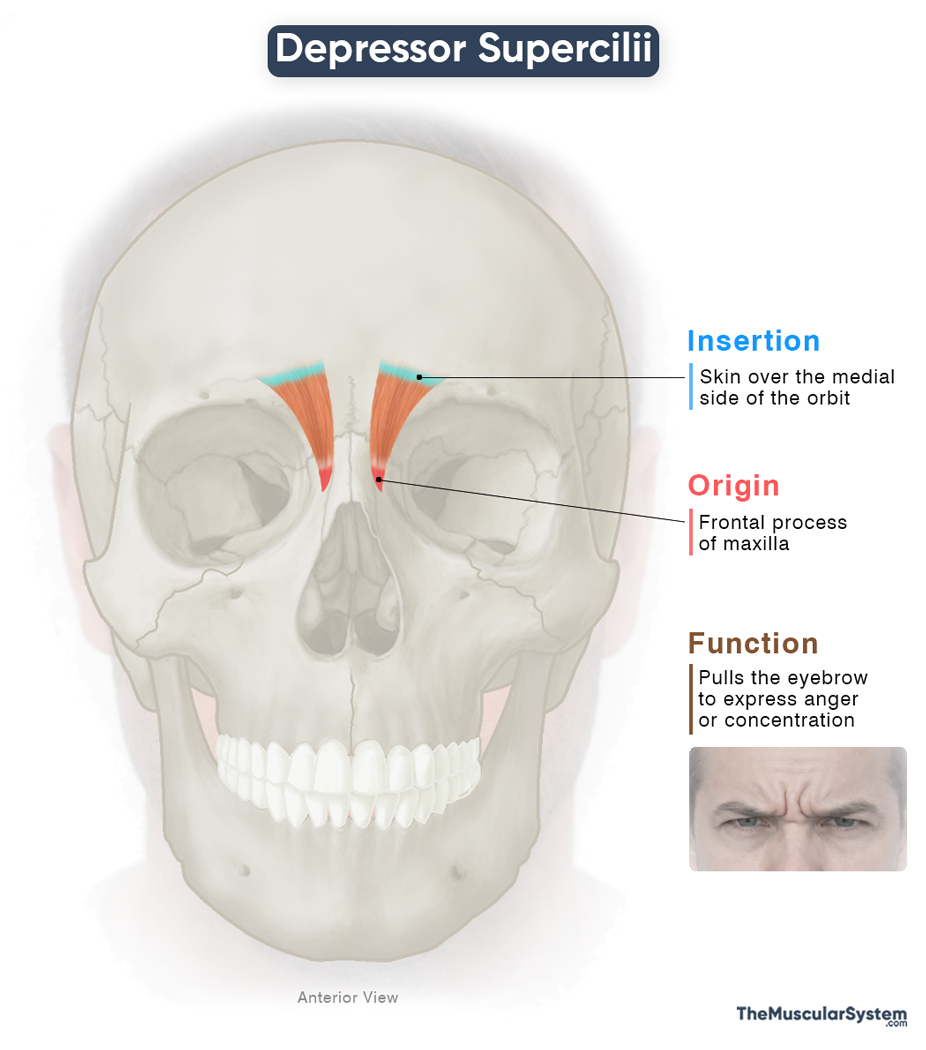
| Origin | Frontal process of the maxilla |
| Insertion | The skin above the medial canthus, over the medial aspect of the orbit |
Origin
The muscle originates from the frontal process of the maxilla bone, specifically the part adjacent to the lacrimal bone, on the medial surface of the orbital rim. It may originate via a single head in some individuals, while presenting two distinct heads in others.
Insertion
The muscle fibers ascend slightly laterally and attach on the medial side of the bony orbit. They are inserted mainly into the overlying skin about half an inch above the inner corner (medial canthus) of the eye, close to the medial half of the eyebrow.
Relations With Surrounding Muscles and Structures
Its insertion lies below that of the corrugator supercilii, and it also blends partly with the superior fibers of the orbicularis oculi. Due to these close relationships, the depressor supercilii has sometimes been described as a subdivision of one of these muscles rather than an individual muscle itself. However, most studies recognize it as a separate muscle with its own attachments and functions.
Function
| Action | Pulling the eyebrows down to form vertical frown lines |
As the name suggests, the depressor supercilii pulls the medial part of the eyebrow downward, contributing to the characteristic frowning expression. When the muscle contracts, its downward tension helps form the vertical glabellar (frown) lines between the eyebrows. It works in synergy with nearby facial muscles such as the corrugator supercilii and procerus, playing a small yet vital role in subtle expressions that show anger, concern, or deep concentration.
Because of its influence on brow position, it is sometimes targeted in cosmetic treatments such as Botox to soften frown lines between the eyebrows.
Antagonists
The muscle does not have a true direct antagonist. Still, the frontalis can be considered functionally antagonistic because it performs the opposite movement by elevating the eyebrows.
Innervation
| Nerve | Temporal branches of the facial nerve |
The temporal branches of the facial nerve (CN VII) innervate this muscle, along with other muscles in the eyebrow and forehead region.
Blood Supply
| Artery | Facial artery |
Blood supply to the muscle comes primarily from the facial artery, a branch of the external carotid artery.
References
- Depressor Supercilii Muscle: Radiopaedia.org
- Depressor Supercilii: Elsevier.com
- Depressor Supercilii: IMAIOS.com
- Depressor Supercilii: HealthLine.com
Della Barnes, an MS Anatomy graduate, blends medical research with accessible writing, simplifying complex anatomy for a better understanding and appreciation of human anatomy.
- Latest Posts by Della Barnes, MS Anatomy
-
Tensor Tympani
- -
Stapedius
- -
Auricularis Posterior
- All Posts


