


Lateral Cricoarytenoid
By
Della Barnes, an MS Anatomy graduate, blends medical research with accessible writing, simplifying complex anatomy for a better understanding and appreciation of human anatomy.
 Della Barnes, MS Anatomy
Last updated:
06/01/2026 Della Barnes, MS Anatomy
UX/UI Designer at - AdobeDella Barnes, an MS Anatomy graduate, blends medical research with accessible writing, simplifying complex anatomy for a better understanding and appreciation of human anatomy.
The lateral cricoarytenoid is a tiny, narrow muscle on the lateral side of the larynx. Also referred to as the anterior cricoarytenoid, it belongs to the intrinsic laryngeal muscle group, which also includes the cricothyroid, posterior cricoarytenoid, oblique arytenoid, transverse arytenoid, and thyroarytenoid muscles.
It is an adductor muscle of the larynx that helps protect the airway and assists in vocalization.
Anatomy
Location and Attachments
| Origin | Upper edge of the cricoid arch on the cricoid cartilage |
| Insertion | Anterior surface of the muscular process of the ipsilateral arytenoid cartilage |
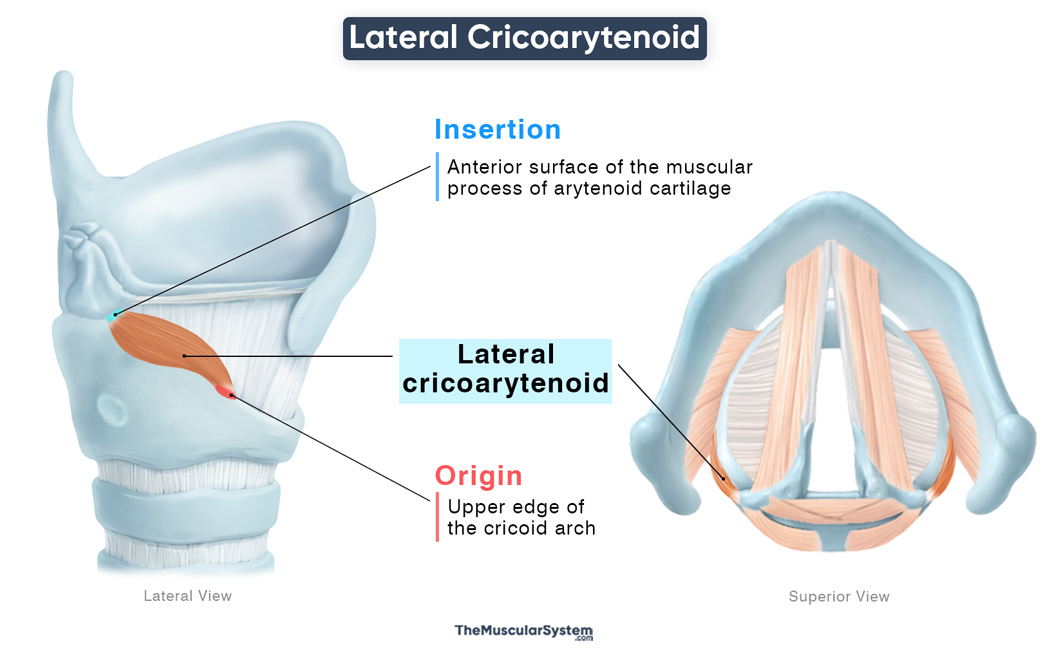
Origin
The muscle originates from the upper border of the cricoid arch, a narrow curved area at the front of the cricoid cartilage.
Insertion
The muscle fibers ascend obliquely backwards along the lateral side of the larynx and insert into the anterior side of the muscular process of the arytenoid cartilage on the same side. This orientation of the muscle fibers from the back to the front along the lateral surface of the larynx earns the muscle its name, lateral (or anterior) cricoarytenoid.
Relations With Surrounding Muscles and Structures
As suggested by its name, the muscle occupies part of the lateral laryngeal wall, with the vocal folds lying medially. It shares its point of insertion at the arytenoid cartilage with two other intrinsic laryngeal muscles, the posterior cricoarytenoid and transverse arytenoid. While the lateral cricoarytenoid approaches the arytenoid from an anterolateral direction, the posterior cricoarytenoid arises from the posterior surface of the cricoid lamina, and the transverse arytenoid spans horizontally between the two arytenoid cartilages.
Function
| Action | — Adducting the vocal folds to help with vocalization — Helping protect the airways by keeping it closed during swallowing |
Being one of the laryngeal adductors, its contraction pulls the muscular process of the arytenoid cartilage anteriorly, causing the arytenoid to rotate medially on the cricoid. This action adducts the vocal folds, which means they are pulled toward each other, closing the anterior membranous part of the rima glottidis. When air from the lungs passes through this narrowed opening, it causes the vocal folds to vibrate, producing sound. This action contributes to vocal intensity and clarity but does not play a primary role in regulating pitch.
The closing of the rima glottidis also helps protect the airway, preventing food and liquid from entering during swallowing.
Antagonists
The posterior cricoarytenoid acts as the principal antagonist of this muscle, rotating the arytenoid cartilages laterally to abduct the vocal folds and open the rima glottidis.
Innervation
| Nerve | Inferior branch of the recurrent laryngeal nerve |
Like the other intrinsic muscles of the larynx, this muscle is innervated by the recurrent laryngeal nerve, specifically its terminal inferior branches. The recurrent laryngeal nerve rises from the vagus nerve (CN X).
Blood Supply
| Artery | Superior and inferior thyroid arteries |
Arterial supply is provided by laryngeal branches of the superior thyroid artery, arising from the external carotid artery, and by the inferior thyroid artery, which arises from the thyrocervical trunk.
References
- Lateral Cricoarytenoid: TeachMeAnatomy.info
- Lateral Cricoarytenoid Muscle: Kenhub.com
- Lateral Cricoarytenoid: Lumen.LUC.edu
- Lateral Cricoarytenoid Muscle: Elsevier.com
- Lateral Cricoarytenoid Muscle: IMAIOS.com
Della Barnes, an MS Anatomy graduate, blends medical research with accessible writing, simplifying complex anatomy for a better understanding and appreciation of human anatomy.
- Latest Posts by Della Barnes, MS Anatomy
-
Tensor Tympani
- -
Stapedius
- -
Auricularis Posterior
- All Posts


