


Transverse Arytenoid
By
Della Barnes, an MS Anatomy graduate, blends medical research with accessible writing, simplifying complex anatomy for a better understanding and appreciation of human anatomy.
 Della Barnes, MS Anatomy
Last updated:
05/01/2026 Della Barnes, MS Anatomy
UX/UI Designer at - AdobeDella Barnes, an MS Anatomy graduate, blends medical research with accessible writing, simplifying complex anatomy for a better understanding and appreciation of human anatomy.
The transverse arytenoid is an unpaired muscle located at the posterior side of the larynx. It belongs to the group of intrinsic laryngeal muscles, which includes the cricothyroid, posterior cricoarytenoid, lateral cricoarytenoid, oblique arytenoid, and thyroarytenoid muscles. In fact, the transverse and oblique arytenoids are sometimes considered two parts of the same muscle, referred to as the arytenoid or interarytenoid.
As one of the laryngeal adductors, this muscle plays a crucial role in protecting the airways during swallowing, as well as in vocalization.
Anatomy
Location and Attachments
| Origin | The posterior surface of the muscular process and the lateral margin of the arytenoid cartilage on one side |
| Insertion | The corresponding area on the contralateral arytenoid cartilage |
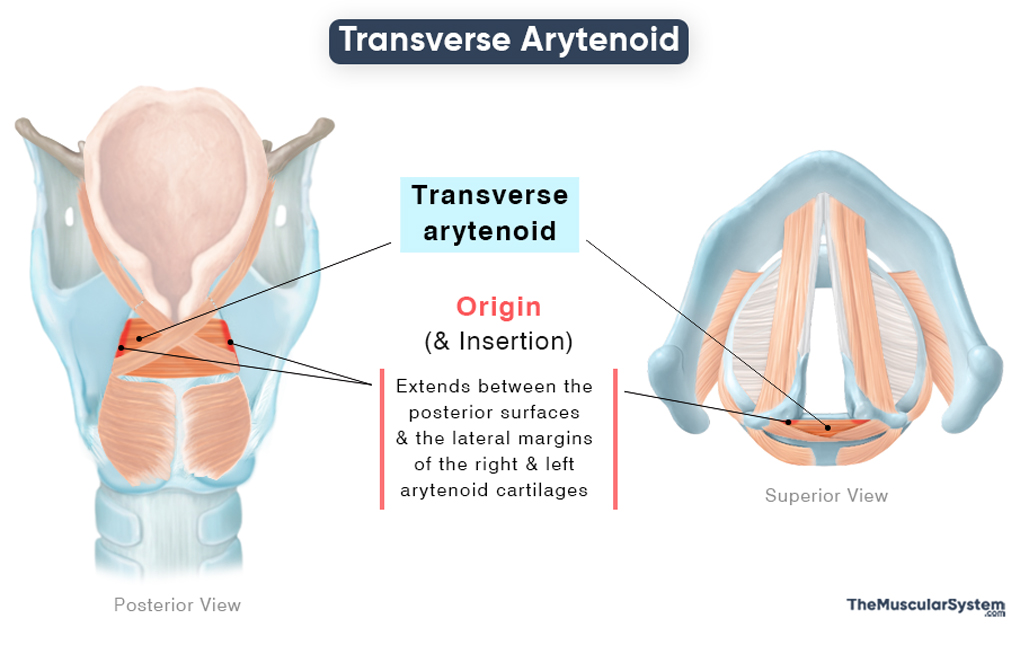
The transverse arytenoid is the only unpaired muscle in the intrinsic laryngeal group. Though it does not have a point of origin and insertion in the typical sense, the muscle spans across the posterior side of the larynx. It starts from the posterior surface of the muscular process and along the lateral margin of the arytenoid cartilage on one side, coursing horizontally across the midline. It then attaches to the corresponding parts of the arytenoid cartilage on the other side.
The muscle gets its name from the transverse direction of its fibers.
Relations With Surrounding Muscles and Structures
At the back of the larynx, the muscle lies just above the cricoid cartilage. It is deep to the oblique arytenoid muscle, bridging the gap between the left and right arytenoid cartilages, filling the space in their concave posterior surfaces.
Function
| Action | — Helping close the laryngeal opening to prevent aspiration of food and water — Assisting in vocalization |
Protection of the Airway
The transverse arytenoid approximates the two arytenoid cartilages when it contracts, like tightening a strap between two points. This brings the posterior parts of the vocal folds closer together and helps close the rima glottidis.
Although the muscle can be voluntarily controlled, it usually acts reflexively during swallowing. When food particles or liquids approach the larynx, it works with other laryngeal adductors, such as the oblique arytenoid, lateral cricoarytenoid, and thyroarytenoid muscles, to close the rima glottidis and prevent aspiration.
Contribution to Phonation
The transverse arytenoid also plays an important role in vocalization by assisting in vocal fold adduction. Acting together with other laryngeal adductors and tensors (cricothyroid), it helps bring the vocal folds close enough to allow subglottic air pressure to build up. Air passing through the narrow gap between the vocal folds causes them to vibrate, which produces sound.
Antagonists
The muscle has no direct antagonist. However, as part of the laryngeal adductor group, its action is functionally antagonized by the posterior cricoarytenoid, the sole abductor of the vocal folds.
Innervation
| Nerve | Recurrent laryngeal nerve |
Primary motor innervation to the muscle comes from the recurrent laryngeal nerve, a branch of the vagus nerve (CN X).
Sometimes, the internal laryngeal nerve, the internal branch of the superior laryngeal nerve, may also supply this muscle, but it is believed to provide sensory innervation.
Blood Supply
| Artery | Superior and inferior thyroid arteries |
Like the other laryngeal muscles, its blood supply comes from the superior and inferior thyroid arteries, branches of the external carotid artery, and thyrocervical trunk, respectively.
References
- Transverse Arytenoid Muscle: Kenhub.com
- Transverse Arytenoid Muscle: IMAIOS.com
- Transverse Arytenoid: Meddean.luc.edu
- Transverse Arytenoid Muscle: Elsevier.com
- Anatomy, Head and Neck: Larynx Arytenoid Cartilage: NCBI.NLM.NIH.gov
Della Barnes, an MS Anatomy graduate, blends medical research with accessible writing, simplifying complex anatomy for a better understanding and appreciation of human anatomy.
- Latest Posts by Della Barnes, MS Anatomy
-
Tensor Tympani
- -
Stapedius
- -
Auricularis Posterior
- All Posts


