


Tensor Tympani
By
Della Barnes, an MS Anatomy graduate, blends medical research with accessible writing, simplifying complex anatomy for a better understanding and appreciation of human anatomy.
 Della Barnes, MS Anatomy
Last updated:
14/02/2026 Della Barnes, MS Anatomy
UX/UI Designer at - AdobeDella Barnes, an MS Anatomy graduate, blends medical research with accessible writing, simplifying complex anatomy for a better understanding and appreciation of human anatomy.
The tensor tympani is a tiny facial muscle in the middle-ear region, involved in controlling how sound vibrations are conducted through the ear. Though small, it plays an important role in steadying the ossicles and moderating the impact of loud or abrupt sounds on the inner ear.
Anatomy
Location and Attachments
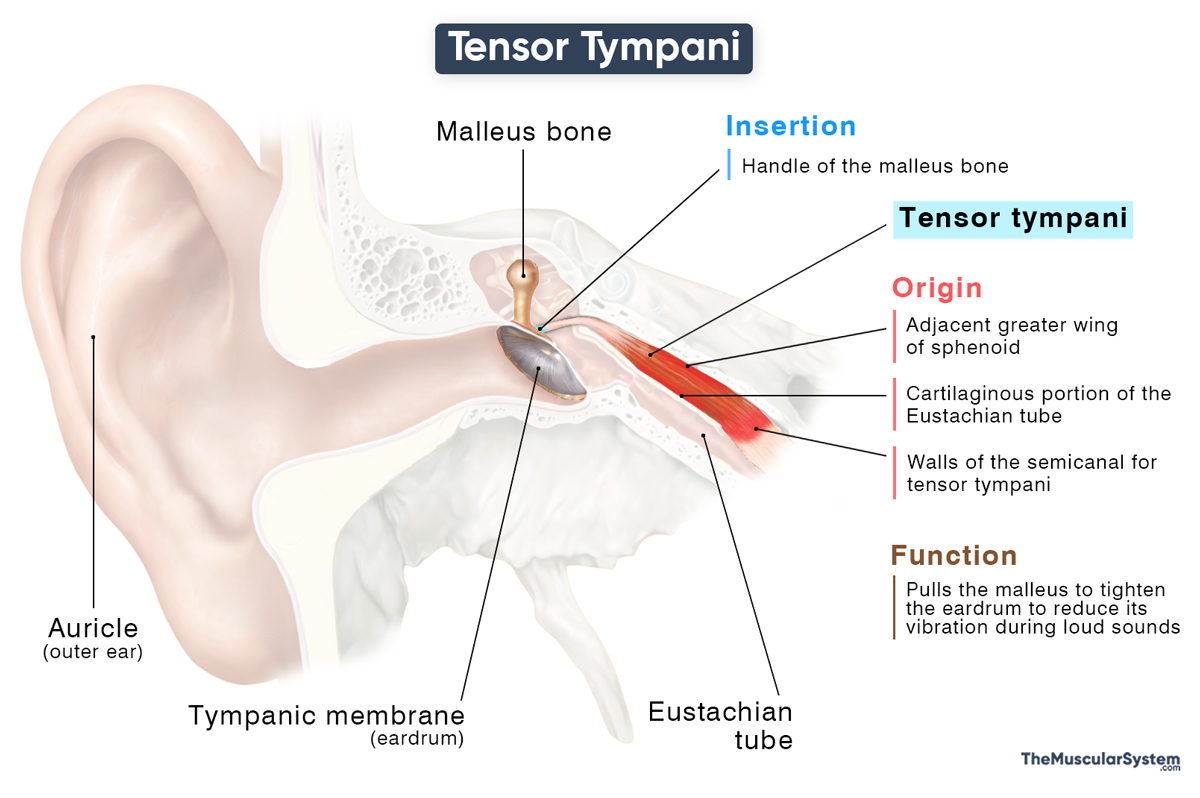
| Origin | The cartilaginous portion of the Eustachian tube, the greater wing of the sphenoid, and the walls of the semicanal for the tensor tympani |
| Insertion | The handle of the malleus bone |
Origin
The muscle arises primarily from the superior surface of the cartilaginous part of the Eustachian (auditory) tube. Additional fibers may originate from the greater wing of the sphenoid. A portion of the muscle can also attach to the walls of the narrow bony canal through which it travels toward the tympanic cavity. This canal, located within the petrous part of the temporal bone, is known as the semicanal for the tensor tympani.
Insertion
The slender muscle belly runs posteriorly through the semicanal and gradually narrows into a delicate tendon that emerges within the tympanic cavity, just above the tympanic opening of the Eustachian tube. Before leaving the semicanal, the tendon makes a lateral turn as it wraps around a pulley-like bony projection called the cochleariform process. It then continues to insert on the medial side of the manubrium mallei or the handle of the malleus, near the base.
Relations With Surrounding Muscles and Structures
Though small itself, the tensor tympani is the larger of the two muscles located within the middle ear, in the tympanic cavity, with the other one being the stapedius, the smallest muscle in the human body. The muscle does not have any muscular relations as it courses through its own bony canal, with only the superior tympanic artery coursing alongside it.
The semicanal for the tensor tympani lies superior and lateral to the bony part of the Eustachian tube. As the two open into the tympanic cavity, they are separated by a horizontal bony plate, the septum canalis musculotubarius.
Function
| Action | Pulling the malleus to tense the eardrum and limit excessive vibration from loud sounds. |
The tensor tympani is a small muscle in the middle ear whose contractions are primarily involuntary, though a few people can voluntarily activate it and perceive a low “rumbling” noise. Its main action is to pull the handle of the malleus medially, which increases the tension on both the ossicular chain (malleus, incus, and stapes) and the tympanic membrane (eardrum).
1. Dampening self-generated sounds
By tightening the eardrum, it reduces the amplitude of sound vibrations transmitted to the inner ear. This protective mechanism helps prevent damage from loud or internally generated sounds. The muscle is particularly active during activities such as chewing, yawning, swallowing, and speaking, dampening the noise produced by one’s own body. Without it, the sounds of your own speech might have been deafening.
2. Modulating sound transmission through the middle ear
As the tensor tympani pulls the malleus inward, it works in the opposite direction of the stapedius, which pulls on the stapes. Together, these opposite pulls increase the tension in the ossicular chain and tighten the eardrum, preventing it from vibrating too much. It may participate in the acoustic reflex, but the stapedius serves as the primary muscle.
3. Responding to startle reflexes
It may also be activated during the startle reflex, contracting in anticipation of loud sounds such as thunder or a door slamming. However, it reacts rather slowly, taking about 40 milliseconds, which makes it unable to protect against sudden, sharp sounds like explosions or gunshots.
Hyperactivity of this muscle can cause tensor tympani syndrome, a condition associated with abnormal ear sensations, tinnitus, and sensitivity to sound.
Antagonists
The tensor tympani does not have true antagonists, as the elastic recoil of the tympanic membrane and ossicular ligaments restores the ossicles to their resting position once the muscle relaxes. However, its medial pull on the malleus is functionally antagonistic to the stabilizing action of the stapedius on the stapes during loud sounds, with the two muscles together contributing to the overall regulation of tension across the tympanic membrane.
Innervation
| Nerve | Medial pterygoid nerve |
The tensor tympani receives its motor innervation from the medial pterygoid nerve, a branch of the mandibular division of the trigeminal nerve (CN V).
Blood Supply
| Artery | Superior tympanic artery |
Blood supply to the tensor tympani is provided by the superior tympanic artery, which arises from the middle meningeal artery, the third branch of the mandibular segment of the maxillary artery.
References
- Tensor Tympani: https://www.Elsevier.com
- Tensor Tympani Muscle | Overview, Function & Syndrome: Study.com
- Tensor Tympani Muscle: Radiopaedia.org
- Tensor Tympani Muscle: Kenhub.com
- The Function of the Tensor Tympani Muscle: A Comprehensive Review of the Literature: PMC.NCBI.NLM.NIH.gov
Della Barnes, an MS Anatomy graduate, blends medical research with accessible writing, simplifying complex anatomy for a better understanding and appreciation of human anatomy.
- Latest Posts by Della Barnes, MS Anatomy
-
Stapedius
- -
Auricularis Posterior
- -
Auricularis Superior
- All Posts


