


Occipitofrontalis
By
Della Barnes, an MS Anatomy graduate, blends medical research with accessible writing, simplifying complex anatomy for a better understanding and appreciation of human anatomy.
 Della Barnes, MS Anatomy
Last updated:
31/01/2026 Della Barnes, MS Anatomy
UX/UI Designer at - AdobeDella Barnes, an MS Anatomy graduate, blends medical research with accessible writing, simplifying complex anatomy for a better understanding and appreciation of human anatomy.
The occipitofrontalis is a large, broad muscle spanning the entire cranium, from the occipital bone in the back to the frontal bone in the front. It forms the epicranial group of facial muscles, along with the temporoparietalis muscle. The occipitofrontalis is one of the primary muscular structures responsible for producing various facial expressions.
Anatomy and Attachments
It is made up of an occipital belly and a frontal belly, both named after their location on the cranium.
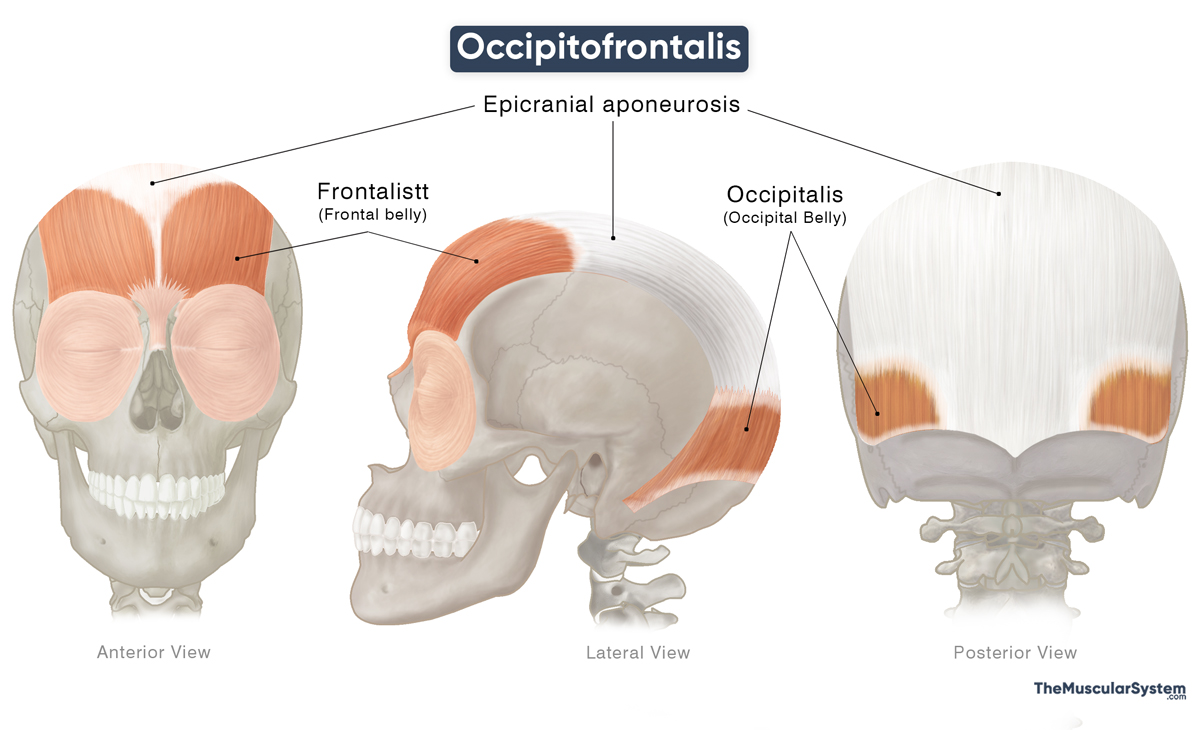
The two bellies are often considered to be separate muscles, connected via the epicranial aponeurosis that covers the top of the skull. They have unique attachments and neurovascular supplies:
| Name | Origin | Insertion | Innervation | Blood Supply |
|---|---|---|---|---|
| Occipitalis (Occipital Belly) | Superior nuchal line of the occipital bone | Back of th epicranial aponeurosis | Occipital branch of the posterior auricular nerve (CN VII) | Occipital and posterior auricular arteries |
| Frontalis (Frontal Belly) | Front of the epicranial aponeurosis | The fascia and skin around the eyebrow and root of the nose | Temporal branch of the facial nerve (CN VII) | Supraorbital and supratrochlear arteries |
Function
It is one of the main muscles for facial expressions.
Role of the Frontal Belly (Fronalis)
- Raising the eyebrows: When the epicranial aponeurosis is fixed, it lifts the eyebrows and forehead, producing expressions of surprise or shock.
- Wrinkling the forehead: When the forehead skin is fixed, it helps pull the scalp forward, creating horizontal wrinkles, helping produce expressions of worry or concern.
Having no direct bony attachments leaves the frontal part to move the skin of the forehead and eyebrows freely.
Role of the Occipital Belly (Occipitalis)
- Scalp retraction: When the nuchal attachment is fixed, it pulls the scalp backward.
- Scalp protraction: When the aponeurosis is fixed, it can move the scalp forward.
Though these movements aren’t very functional alone, they stabilize the epicranial aponeurosis, enhancing the frontal belly’s ability to move the scalp and produce facial expressions.
References
- Occipitofrontalis Muscle: Kenhub.com
- Occipitofrontalis Muscle: Elsevier.com
- Occipitofrontalis Muscle | Action, Location & Insertion: Study.com
- Occipitofrontalis Muscle (Anatomy): PrimaryCareNotebook.com
Della Barnes, an MS Anatomy graduate, blends medical research with accessible writing, simplifying complex anatomy for a better understanding and appreciation of human anatomy.
- Latest Posts by Della Barnes, MS Anatomy
-
Tensor Tympani
- -
Stapedius
- -
Auricularis Posterior
- All Posts


